
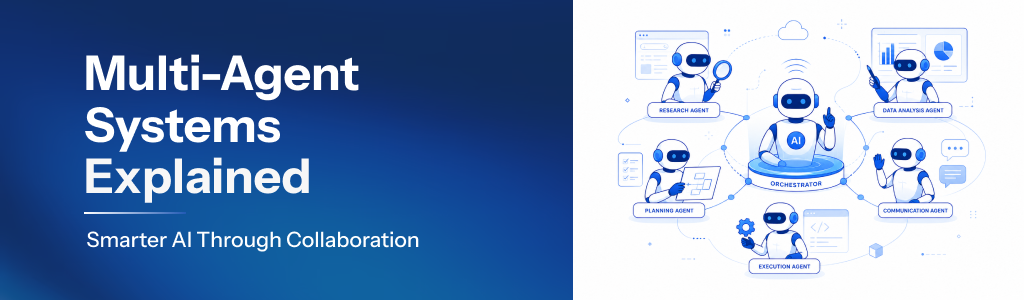
Artificial Intelligence is constantly developing, and Multi-Agent Systems (MAS) have now become an essential element of contemporary intelligent systems. Unlike traditional AI models that are used to address problems individually, MAS consists of several agents working in cooperation with each other for problem solving.
What are Multi-Agent Systems?
The Multi-Agent System is made up of several intelligent agents that interact, collaborate, and take their own decisions while trying to achieve a particular goal. Every agent has a particular job to do in order to make the system efficient.
Key Features of Multi-Agent Systems
• Collaboration: Agents work together to achieve shared goals.
• Autonomy: Each agent operates independently.
• Scalability: New agents can be added as requirements grow.
• Adaptability: Agents respond to changing environments in real time.
Benefits of Multi-Agent Systems
• Faster decision-making
• Improved efficiency and automation
• Better resource utilization
• Enhanced reliability through distributed operations
Conclusion
With advancements in AI applications, Multi-Agent Systems allow intelligent agents to collaborate more intelligently with one another. With their capability to effectively solve difficult problems, Multi-Agent Systems can be used as a technological tool by many industries in developing smart systems.