
When an application is new, a single database is usually enough. It handles user requests, stores data, and everything runs smoothly.
But things change as the application grows.
More users join, more data gets stored, and thousands of requests start hitting the database at the same time. Queries that once took milliseconds begin taking longer, and sooner or later, the database becomes the biggest performance bottleneck.
This is where database scaling comes into the picture.
Why Does Database Scaling Matter?
Every successful application reaches a point where simply upgrading to a larger database server isn’t enough. There’s only so much one machine can handle.
To keep applications fast and reliable, developers often scale the database itself. Two of the most common ways to do that are Replication and Sharding.
Although both improve performance, they solve different problems.
What Is Replication?
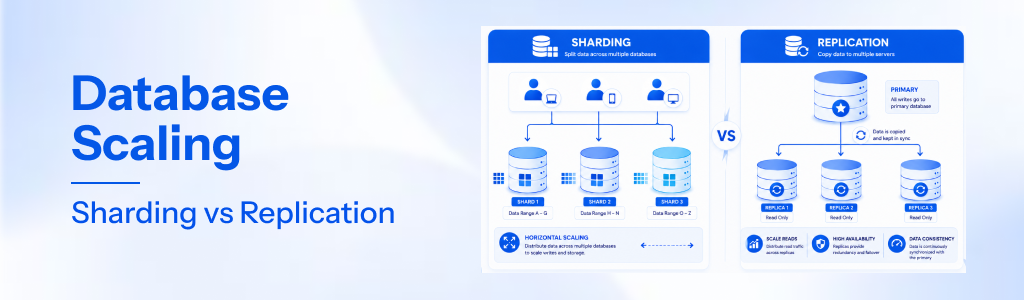
Replication means creating one or more copies of the same database.
Typically, one server acts as the primary database, handling all write operations, while the replicas take care of read requests.
Imagine a news website where thousands of users are reading articles, but only a few editors are publishing new ones. Instead of sending every request to a single database, read traffic is shared across multiple replicas, making the application much more responsive.
Replication is a great choice when your application receives far more reads than writes.
What Is Sharding?
Sharding takes a completely different approach.
Instead of copying the database, it splits the data across multiple database servers. Each server stores only a portion of the total data.
For example, an e-commerce platform might store customers from different regions in different shards. Since each server manages a smaller dataset, queries become faster and the system can continue growing without depending on a single database.
Sharding is especially useful when both your data size and write traffic continue to increase.
So, Which One Should You Choose?
There isn’t a single answer.
If your application mainly struggles with heavy read traffic, Replication is often the simpler solution.
If one database can no longer handle the amount of data or write operations, Sharding becomes the better option.
In fact, many large-scale platforms combine both techniques to handle millions of users efficiently.
Conclusion
Database scaling isn’t about using the most advanced architecture – it’s about solving the right problem at the right time. Understanding the difference between replication and sharding helps developers design systems that can grow confidently without sacrificing performance or reliability.