
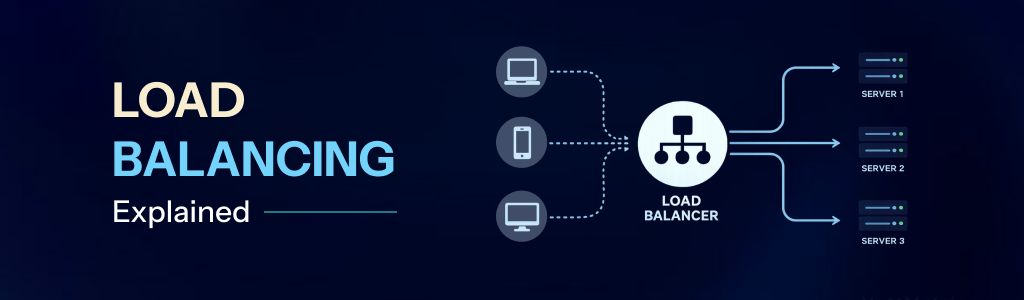
Imagine you’ve built a web application that suddenly starts getting thousands of users every day. At first, everything works smoothly. But as traffic grows, users begin complaining about slow loading times, failed requests, and occasional crashes.
The interesting part is that your code may not be the problem at all. The real issue could be that a single server is trying to handle everything on its own.
This is exactly where load balancing comes in.
What is Load Balancing?
Think of a supermarket with multiple billing counters. If every customer is forced to stand in a single queue, things quickly become chaotic. But when customers are distributed across multiple counters, everyone gets served faster.
Load balancing follows the same principle.
Instead of sending all incoming requests to one server, a load balancer intelligently distributes traffic across multiple servers. This prevents any single server from becoming overwhelmed and helps keep the application responsive.
Why Does It Matter?
As developers, we often focus on building features. But once an application starts attracting real users, performance and reliability become just as important.
Without load balancing:
• Servers can become overloaded
• Response times increase
• Applications may crash during traffic spikes
• Users experience a poor experience
How Does It Work?
A load balancer acts like a traffic controller.
When a user sends a request, the load balancer decides which server should handle it. The decision can be based on different strategies:
• Round Robin: Requests are distributed one after another across servers.
• Least Connections: Traffic is sent to the server with the fewest active users.
• IP Hash: A user is consistently routed to the same server.
The goal is simple: keep the workload evenly distributed.
A Real-World Example
Think about an online shopping platform during a festive sale. Thousands of users may be browsing products and placing orders at the same time.
Without load balancing, one server could become overloaded and slow down the entire platform. With load balancing, requests are spread across multiple servers, helping the website stay fast and available even during peak traffic.
Final Take
Load balancing is one of those technologies that users never notice when it’s working – but they immediately notice when it’s missing. As applications grow, distributing traffic efficiently becomes essential for maintaining performance, reliability, and a smooth user experience. For developers, understanding load balancing is a key step toward building systems that can handle real-world traffic with confidence.