
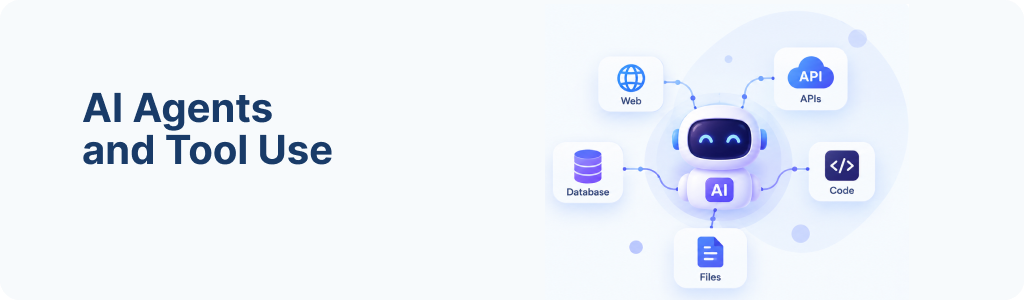
A chatbot can answer questions, summarize a document, or write an email. But what if you want the AI to actually do something?
For example, you ask an assistant to find a flight, check your calendar, send a message, or look up information from a company database. The AI needs more than language skills to complete these tasks. It needs access to tools.
That’s where AI agents and tool use come in.
What is an AI Agent?
An AI agent is a system that can understand a goal, decide what steps are needed, and use available tools to complete the task.
Unlike a basic chatbot that simply responds to a prompt, an agent can work through multiple steps.
For example, if you ask:
“Find my latest order and tell me when it will arrive.”
The agent might first identify the order, call an order-tracking API, get the delivery information, and then explain the result.
The user sees one simple response, but several actions may happen behind the scenes.
What is Tool Use?
Tools give an AI system access to capabilities it doesn’t have on its own.
These tools could include:
• APIs
• Databases
• Search systems
• Calculators
• Internal business applications
• External services
The AI decides when a tool is useful and provides the information needed to call it. The application then executes the tool and sends the result back to the AI.
A Simple Example
Imagine an AI assistant for an online store.
A customer asks:
“Is the black jacket available in medium?”
The agent doesn’t need to guess. It can call an inventory function with the product and size, receive the current stock information, and respond with the actual result.
For a more complex request, it might use several tools one after another.
Final Take
AI agents are essentially a bridge between understanding a request and taking action.
The LLM provides the reasoning and language capabilities, while tools give the system access to real data and actions. When these pieces are designed properly, AI can move from simply answering questions to helping complete real tasks.