
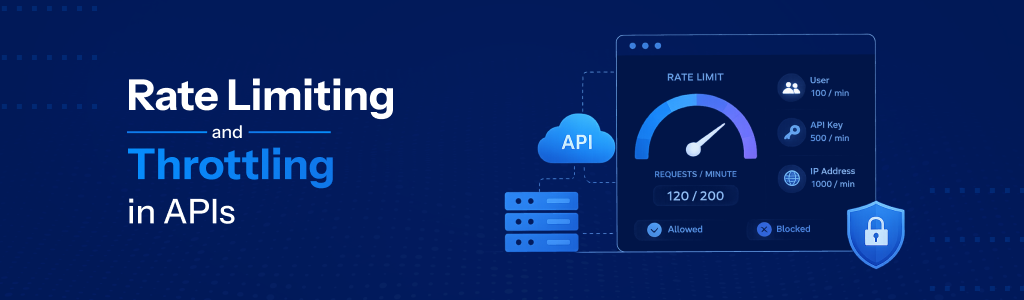
When APIs start getting real traffic, one problem shows up pretty quickly – too many requests at the same time. Sometimes it’s genuine traffic growth, sometimes it’s bots, and sometimes it’s simply a badly configured client repeatedly hitting the same endpoint.
Either way, without proper control, even a well-built API can slow down or become unstable. That’s where rate limiting and throttling come into play.
What is Rate Limiting?
Rate limiting sets a limit on how many requests a client can make within a certain time frame.
For example:
• 100 requests per minute
• 1000 requests per hour
Once that limit is crossed, the API temporarily blocks additional requests.
The idea is simple: stop one user or service from consuming too many resources and affecting everyone else.
What About Throttling?
Throttling is slightly different.
Instead of immediately blocking requests, it slows things down when traffic becomes too high. Think of it like controlling traffic on a busy road rather than completely closing it.
This helps APIs stay responsive even under heavy load.
In most systems, rate limiting and throttling work together rather than separately.
Why It Matters In Real Systems
Traffic isn’t always predictable.
A sudden spike in users, automated scripts, or repeated retry requests can quickly put pressure on APIs. Without any control layer, response times increase and failures start spreading across the system.
That’s why these mechanisms are not just security features – they’re stability features too.
They help teams:
• Prevent API abuse
• Reduce unnecessary server load
• Protect against brute-force attempts
• Maintain fair usage across clients
A Simple Example
Imagine a login API receiving thousands of requests from the same IP address within a few seconds.
Without limits, the server may struggle to handle legitimate users. With rate limiting in place, excessive requests are blocked automatically before they create bigger problems.
Similarly, throttling can slow down heavy traffic instead of letting the system get overwhelmed all at once.
Final Take
Rate limiting and throttling are less about restricting users and more about protecting system health. As APIs grow and traffic becomes unpredictable, having proper request control in place becomes essential for maintaining performance, reliability, and security.