
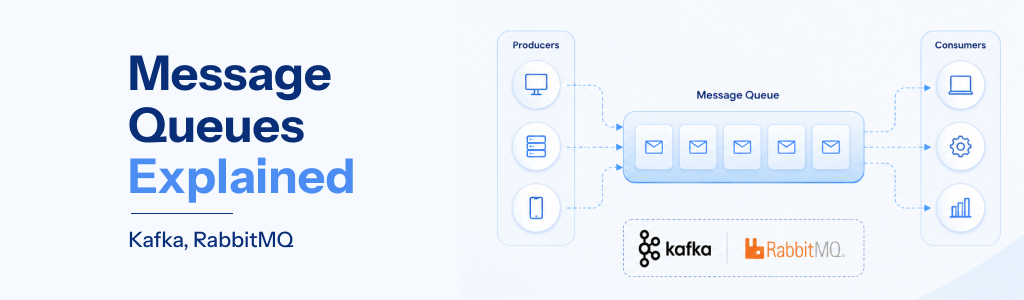
Imagine you’re building an online shopping application. A customer clicks “Place Order”, and within seconds several things need to happen – payment is processed, inventory is updated, a confirmation email is sent, and the order details are shared with the delivery system.
Now imagine making the user wait until every one of these tasks finishes.
Not a great experience, right?
Instead, most modern applications process the order immediately and let the remaining tasks happen in the background. That’s exactly where message queues come into the picture.
What is a Message Queue?
A message queue is a communication layer between different services.
Instead of one service directly waiting for another to complete its work, it simply sends a message to the queue and moves on. Whenever the receiving service is ready, it picks up the message and processes it.
This small change makes a huge difference. Services become independent, failures are easier to handle, and the application stays responsive even during heavy traffic.
Why Are Message Queues Important?
As applications grow, services become more interconnected.
Without a message queue, if one service slows down or becomes unavailable, others may also be affected.
Using message queues helps teams:
• Process tasks asynchronously
• Reduce dependency between services
• Handle sudden traffic spikes
• Improve fault tolerance
• Build scalable microservices
It’s one of those technologies users never notice but they definitely benefit from it.
Kafka vs RabbitMQ
Although both help services communicate, they’re built with different goals in mind.
RabbitMQ
RabbitMQ is ideal when messages need to be delivered and processed reliably.
It’s commonly used for background jobs, email notifications, payment processing, and task queues where each message is handled once and then removed.
Kafka
Kafka is designed for processing massive streams of events.
Instead of deleting messages after they’re consumed, Kafka keeps them for a configurable period, allowing multiple services to read the same events independently. That’s why it’s widely used for event-driven systems, activity tracking, analytics, and real-time data pipelines.
Conclusion
Message queues aren’t just about sending messages – they’re about making applications work more efficiently behind the scenes. Whether you choose RabbitMQ for reliable task processing or Kafka for large-scale event streaming depends on your requirements. Understanding where each one fits is an important step toward building scalable and resilient distributed systems.